
There is something unforgettable about Vanessa in The Little Mermaid.
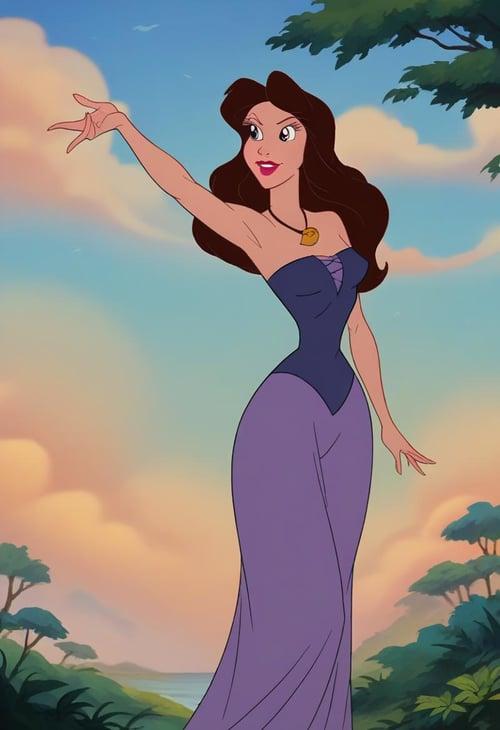
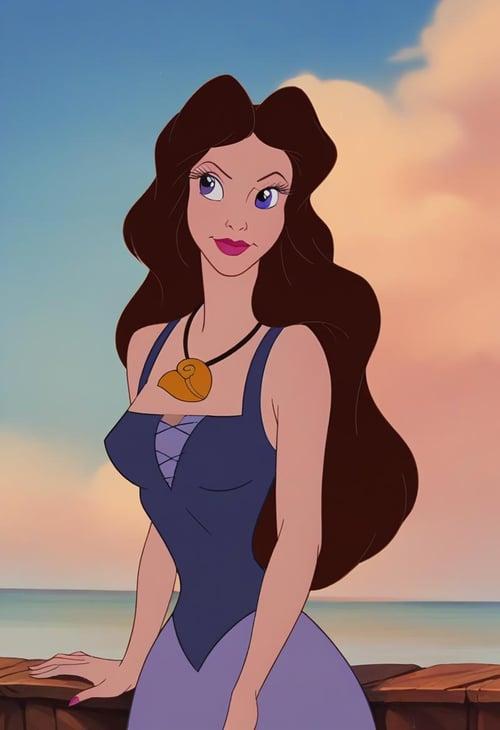
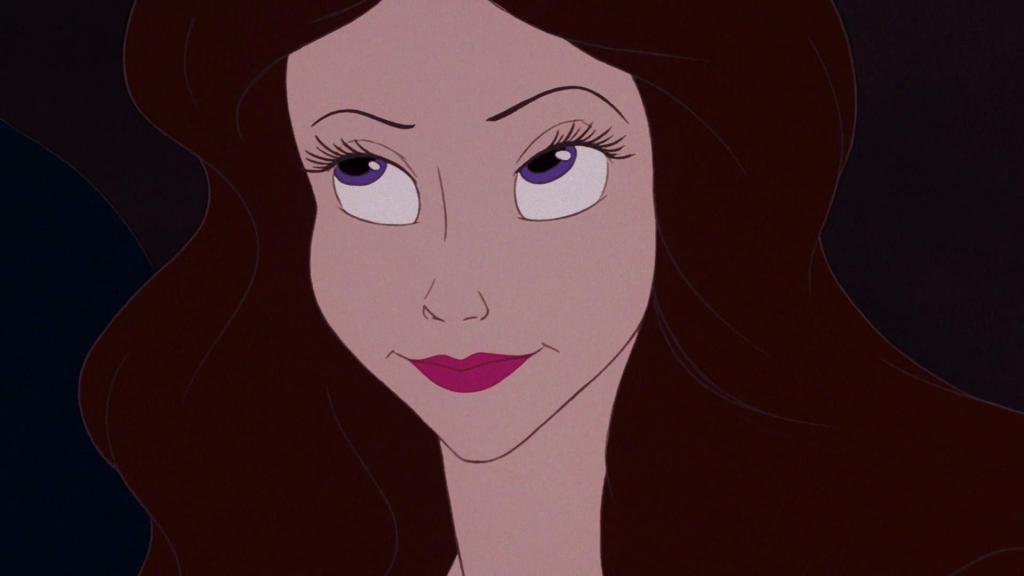
She appears for only a brief portion of the film, yet decades later she remains one of Disney’s most visually compelling characters. With cascading dark hair, violet eyes, a fitted lavender dress, pink lips, and a golden seashell necklace at her throat, Vanessa possesses the kind of beauty that feels almost unreal.
And, of course, it is.
Vanessa is a constructed identity. She is beautiful by design.
That is precisely what makes her so fascinating.
Beauty as Composition
Vanessa’s beauty isn’t presented as effortless innocence. It is composed, intentional beauty.
Every element contributes to the finished image.
Her dramatically long dark brunette hair creates movement and contrast. Her lavender dress emphasizes her silhouette. Her makeup gives her features definition. The golden shell necklace creates an unmistakable focal point. Her posture is poised. Her expressions are controlled.
Nothing feels accidental.
This separates Vanessa from many of Disney’s traditional heroines. Ariel is beautiful while swimming through the ocean, collecting treasures, or waking up on the beach with tangled hair. Belle’s beauty exists alongside her books, provincial routines, and intellectual curiosity.
Vanessa’s beauty, by contrast, is theatrical. I am fascinated by this concept because this character is an example of how beauty can be created in a number of ways.
She enters the story already finished to impersonate Ariel in another form.


The Importance of the Vanity
Perhaps no image captures Vanessa better than the moment we see her before the mirror.
She brushes her extraordinarily long hair at a vanity while admiring her reflection. Through the mirror, her true identity is temporarily revealed to the audience.
It is an extraordinarily clever piece of visual storytelling, but the vanity itself matters.
For centuries, the vanity has represented the private ritual of feminine presentation: perfume bottles, hairbrushes, powders, jewelry boxes, mirrors and beautiful little objects assembled in one intimate space.
The vanity is where appearance becomes ritual.
And Vanessa belongs there perfectly.
She doesn’t simply have long hair. She brushes it.
She doesn’t simply wear a necklace. The necklace is essential to her transformation.
She doesn’t merely happen to look glamorous. She participates in the maintenance of the image.
That distinction is what makes Vanessa so interesting as a beauty archetype.
Beauty Doesn’t Have to Always Look Effortless
Modern beauty culture has a curious obsession with appearing effortless.
The ideal is often presented as waking up beautiful, applying “no-makeup makeup,” at all times and wearing hair that looks accidentally perfect, and pretending that an immaculate appearance required almost no thought.
Vanessa represents almost the exact opposite.
Her aesthetic invites us to appreciate the artifice of beauty.
Hair can be styled.
Makeup can transform a face.
Clothing can create a silhouette.
Jewelry can become a signature.
Perfume can establish an atmosphere.
A mirror can be enjoyed rather than avoided.
There is something refreshing about admitting that beauty can be a creative practice. Once we relinquish our own cultural understanding of this, we can embrace this as an opportunity to be our best selves (within healthy limitations).
Getting ready doesn’t always need to be disguised as something we barely thought about. Sometimes choosing the lipstick, curling the hair, fastening the necklace, applying the perfume, and looking in the mirror are part of the pleasure.
This is the rise of the “Great Ready With Me” culture and why The New York Times recently wrote an article about how the vanity table is popular again for this reason. It should have never gone out of style. The vanity has a purpose throughout history.
The Power of a Signature
Vanessa also demonstrates something that many of the most memorable women—fictional and otherwise—understand instinctively:
A distinctive image is often more powerful than a complicated one.
Vanessa doesn’t have dozens of competing visual elements.
She has a few exceptionally strong ones.
Dark, voluminous hair.
Lavender and purple.
Pink lips.
A fitted silhouette.
A gold seashell necklace.
You could remove almost everything else and still recognize her.
That is the difference between simply following beauty trends and developing a personal aesthetic.
Intentional beauty asks different questions.
What colors make you feel most like yourself?
What hairstyle creates the presence you want?
Which jewelry do you reach for repeatedly?
What lipstick makes your face suddenly look complete?
Which perfume feels right to leave the house wearing?
Over time, repetition turns these choices into signatures.
The Necklace Changes Everything
Vanessa’s seashell necklace deserves special attention because it demonstrates how powerful one accessory can become.
The necklace isn’t merely decoration. It contains Ariel’s voice, making it central to the plot. But visually, it also completes Vanessa.
Against her dark brunette hair and lavender dress, the golden shell immediately draws the eye toward her face and throat. It is unusual enough to be memorable without overwhelming the rest of her appearance.
It gives her beauty a symbol.
This is something worth borrowing from fictional characters. A personal style becomes much more memorable when there are recurring motifs within it—a particular flower, gemstone, pendant, color, hairstyle or accessory.
You don’t necessarily need more.
Sometimes you need your version of the seashell necklace.
Softness With an Edge
Vanessa is also an interesting alternative to femininity that is exclusively sweet.
Her appearance is undeniably feminine, but it isn’t innocent.
The long hair is romantic, yet dramatic. The lavender is pretty, yet mysterious. Her silhouette is traditionally feminine, yet commanding. Her necklace is beautiful, yet possesses extraordinary power.
There is tension within the beauty.
And tension often makes an aesthetic more compelling.
A pink bow becomes more interesting beside dark brunette hair. Pearls feel different with a fitted black dress than usually paired with a sundress. Romantic curls can be paired with a sharper silhouette. A delicate perfume bottle can sit on an antique dark-wood vanity.
Femininity doesn’t have to choose between softness and power.
It can contain both.

Beauty as a Ritual of Becoming
Perhaps this is what I love most about Vanessa’s presentation.
Beauty, in her world, is transformational.
Of course, The Little Mermaid makes that idea literal. Vanessa herself is a magical transformation. But outside the supernatural context, there is something familiar about the idea.
A vanity can be a tiny stage for becoming.
You sit down looking ordinary. You brush your hair. You arrange it differently. You apply color to your lips. You put on earrings. You fasten a necklace. You add perfume.
Nothing fundamental about you has changed.
And yet when you stand up, you may carry yourself differently.
That doesn’t make the transformation false.
Beauty rituals can be a form of creative self-authorship: deciding how we want to present ourselves to the world and enjoying the process of bringing that image to life.
The Vanessa Principle
Vanessa’s beauty philosophy could ultimately be reduced to something very simple:
Don’t merely be beautiful. Compose beauty.
Choose deliberately.
Find your colors. Develop your signatures. Take care of your hair. Wear the jewelry that makes you feel transformed. Keep beautiful objects on your vanity. Enjoy perfume. Enjoy makeup. Enjoy dresses. Enjoy looking in the mirror when you’ve created something you love.
There is no requirement that femininity appear accidental in order to be authentic.
Vanessa’s beauty is memorable precisely because we can see the artistry behind it.
The hair, the necklace, the silhouette, the colors, the vanity… they work together to create something larger than any individual feature.
And perhaps that’s why a character who occupies so little of The Little Mermaid has remained so visually captivating.
Vanessa doesn’t simply enter the story beautiful.
She enters it composed.
 rosybvm.com