
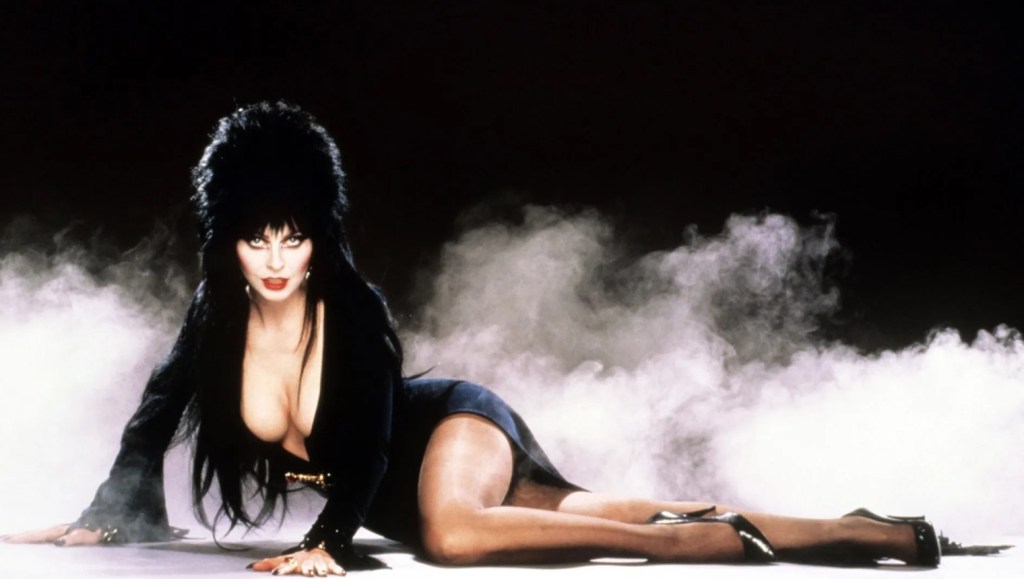
The Legendary Elvira, Mistress of the Dark

Happy Halloween! Elvira, Mistress of the Dark, is undoubtedly, the Queen of Halloween, for all time to come. Cassandra Peterson, the woman behind the character, has been in costume since her character’s spooky film debut in 1988. Since Halloween is upon us, I think it’s fascinating to highlight the feminine depths of Elvira’s spooky character, a legendary figure of the Halloween season since her campy film debut in the 80’s. She is perhaps one of the most fascinating characters of America’s Halloween culture. Her costume has not changed much since her debut, which means her character remains consistent and memorable for the public. In 2021, Julien’s Auctions held an auction of Elvira’s personal collection. It sold remarkably well! Her original costume dress sold for $10,000 alone. I think there is much to appreciate about how Elvira contributed to Halloween culture in general.

I am most fascinated by Elvira’s femininity and the overlap of the occult has with strong feminine energy, which has historically been relegated into arenas of witchcraft and became generally stigmatized as something to fear by mainstream Western society. For example, the origin of Friday the 13th, was a Pagan day for worshipping Divine Feminine energy. It would later be transitioned as a patriarchal day to fear in general (spooky Friday the 13th is quite feminine!) and has various religious and cultural roots. For example, it’s said that in Christianity, Judas was the 13th supper attendee of the Last Supper, who betrayed Jesus, and then Jesus was crucified on a Friday. This is one example of Friday the 13th being perceived as a fearful day, when in actuality, the historical origin of the number 13 for Friday the 13th is that women usually have 13 menstrual cycles in a year and Friday is a day to worship the female from Paganism. The various connection points of Friday the 13th are fascinating to observe. The belief of bad omens for Friday the 13th has been embedded in cultures for quite a while, though. Arnold Schoenberg, the Austrian-American composer, was so fearful of the number 13, he omitted the 13th measure in some of his musical compositions. The musician Taylor Swift has a deep belief in the good luck the number 13 has brought her throughout her life.

The feminine origin of Friday the 13th now been recently resurging through a renewed cultural interest in the history of the divine feminine again, which is ironically re-entering into mainstream discourse. I think this is similarly aligned with the mainstreaming of strong feminine energy for Halloween culture. For example, it’s become a norm for celebrities to dress up in the weeks leading up to Halloween in near perfect costume recreations of characters like Elvira. In 2022, Kylie Jenner famously recreated Elvira’s costume which introduced Elvira to a younger generation.

Kylie Jenner as Elvira

I appreciate how Cassandra Peterson crafted a persona and character which feels like a parody of the occult and continues to elevate femininity in spite of the fearful and spooky mask of makeup she wears. She is also a fashion icon for it. According to W Magazine, it was when Elvira was a child that she asked her mom if she could become the “Queen of Halloween” for her costume. That year, she ended up dressing as Morticia Addams, of the fictional and spooky Addams Family. The Addams Family was created as stand-alone comics by Charles Addams for The New Yorker between 1938 and 1988. The comics became films, and Morticia is seen as the Matriarch and feminine energy of a group of old-money people who delight in the macabre (perhaps a fascinating social commentary on institutions which do not reform become macabre). The TV series debuted on ABC in 1964 and ran for two seasons. The origin story of Elvira is most certainly tied into the origin story of Morticia Addams.

The Morticia Addams role reprised by Carolyn Jones, Angelica Huston, and Catherine Zeta-Jones through the years looks similar to Elvira, Mistress of the Dark for a reason… Elvira was inspired by her!

Elvira was born in Kansas in 1951. During her childhood, she has stated she was with fascinated horror themed toys instead of Barbies. Later into her career, she would become involved with Playboy and would guest star on the hit E! television show, The Girls Next Door, where she would often make jokes about how dying her hair blonde be a spooky thing for her — the macabre was always her element. She hosted the film, Hef’s Halloween Spooktacular, which was about the making of the annual Playboy Halloween Party, often known to be the most spooky Halloween party in all of Hollywood. She bonded closely with Bridget Marquardt (the real-life woman who inspired the film The House Bunny) as Bridget was the resident of the Playboy Mansion who was most committed to Halloween and the horror genre. To this day, they remain connected over their feminine connection the macabre. I think there is something noteworthy about how women can find common ground in any topic, and genuinely support one another, no matter how different their personality and style may be!

Bridget Marquardt and Elvira at the Playboy Mansion in 2006

In 2021, Elvira released a memoir about her life entitled, Yours Cruelly, Elvira: Memoirs of the Mistress of the Dark. Her book is a must-read if you’re a fan of Halloween culture. In the meantime, enjoy watching her many films this Halloween night!

Pin-Up History: Betty Grable

Betty Grable made an impact on America. In the 1940s, Betty Grable was the highest paid woman in America. She had the highest salary of a woman in the country in the years 1946-1947. Throughout her career, she made over $3 million. Betty, undeniably, held a grip over American culture… over the course of her 42 films during the 1930s and 1940s, they grossed a net of $100 million. For those times (and today), those numbers are astounding. During WWII, she surpassed Rita Hayworth as the top pin-up girl, which Life magazine referred to as “100 Photographs That Changed The World.”

Born Elizabeth Ruth Grable on December 18, 1916 in St. Louis, Missouri, she was the youngest of three children of a Midwestern family. She was pressured to become a performer by her mother and achieved many accolades and won beauty contests frequently. Despite this, she suffered from a fear of crowds and sleepwalking. Her career in Hollywood began in 1929, shortly after the stock market crash, when she traveled with her mother to California. She studied at the “Hollywood Professional School,” and attended dance classes as well. In 1930, she signed under Samuel Goldwyn and became one of the original “Goldwyn Girls.” She led one of the musical numbers titled, “Cowboys,” yet received no on screen credit for the performance. She went on to sign with RKO Radio Pictures in 1932. It is infamously remarked by Marilyn Monroe how she used to stare longingly at an RKO tower from her orphanage window as a child, which helped her solidify her dream of becoming a performer – Betty and Marilyn would later perform together alongside Lauren Bacall. The stars do align!

Following her time with RKO, Betty would sign with Paramount Pictures, even further advancing her career in Hollywood. However, her performances at the time were being overshadowed by those of Judy Garland, especially from The Wizard of Oz, which captured America’s heart in the 1930s. However, she persisted in Hollywood and by 1939, she was performing alongside her husband, Jackie Coogan, in a film called Million Dollar Legs. For a time of such embedded objectification of women in Hollywood, it feels rather ironic that a woman’s career successes could be rooted in that. However, I believe much of female performances by leading ladies in Golden Age Hollywood have been overlooked tremendously for the actual work that they did, with too much emphasis on the idea of their image. This is especially commented on in Richard Barrios new book about Marilyn Monroe’s performances, On Marilyn Monroe, which details the incredible body of work she helped create (and how she was a discerning script reader for films and characters), and this was often overlooked or heavily critiqued by film critics who had no tact in understanding some of the nuanced genius of these performances.

Grable would continue to move film studios, landing in 1940 at 20th Century Fox, and by then, she stated that she felt “sick and tired” of performing and that she was considering retirement. She was given close attention by the head of Fox at the time, Darryl Zanuck (who infamously did not like Marilyn Monroe and held her career back as much as he could). In 1940, this was far before Marilyn’s beginnings at Fox, Grable was cast as lead in Down Argentine Way, replacing Alice Faye, who had been the most popular musical film star at the time. For many who study Golden Age Hollywood like I do, it becomes exceedingly clear that men were deciding the career outcomes of women and they were playing puppet master to who would advance in their career. This does not, however, negate the quality of these performances.

Often, even in times of career burnout (as Grable had discussed wanting to retire), she again stepped up and did a fantastic performance. Over and over again, women have shown persistence in times of tremendous challenge and strength in the face of male dominant, chauvinistic systems created to cast them out just as quickly as they arrived. I would argue that women of Golden Age Hollywood were true icons for this reason. They carried the weight of contractual burdens of the system, performed nearly to no end, and maintained an image of near perfect good looks… no wonder their personal lives were often left troubled.

If there is anything to be truly appreciative of in these remarkable storied lives of Hollywood’s bygone icons, is that there are ways to renew your own appreciation in the importance of living a balanced life, and of the understanding of our limitations for our own health and wellness, not to see as a hinderance, but as a way to guide your decisions in healthy living. Many of these female performers were pushed to limits which became unhealthy. Betty Grable, among many other women in Hollywood, were being stretched to maximum capacity, were excessively critiqued, and yet, created and generated so many profits for Hollywood (and were considered incredibly attractive). The best way we can appreciate their impact today is by remembering their work and respecting them for it.

In 1943, Betty Grable was voted the “Number One Box Office Draw,” by moviegoers – outranking male icons such as Bob Hope, Clark Gable, and Humphrey Bogart. This favorite box office vote was again regained in 1950. By the early 1950s, Betty could not find scripts she wanted to perform for and her career began to decline. Marilyn Monroe replaced her in Gentlemen Prefer Blondes.

Holistically, women in Hollywood were put in competition too often and were isolated in that way, too. Betty was a pioneer through some of Hollywood’s most incredible times. According to director Martin Scorsese, “Looking back at the pictures of the ’30s and ’40s, the period now known as the Golden Age of Hollywood, you can feel, more and more, just how controlled many of the performances were, especially in relation to movies made after the arrival of Brando and James Dean in the ’50s. There’s a tension between directors and actors that I find extremely interesting now.” Scorsese summarizes all there is to be said about the time that Betty performed in. I think we should celebrate her for this.

Betty Grable passed way of lung cancer in 1973 at age 56 in Santa Monica, CA.

Source: Wikipedia

Betty Grable and Carmen Miranda in Springtime in the Rockies (1942).