
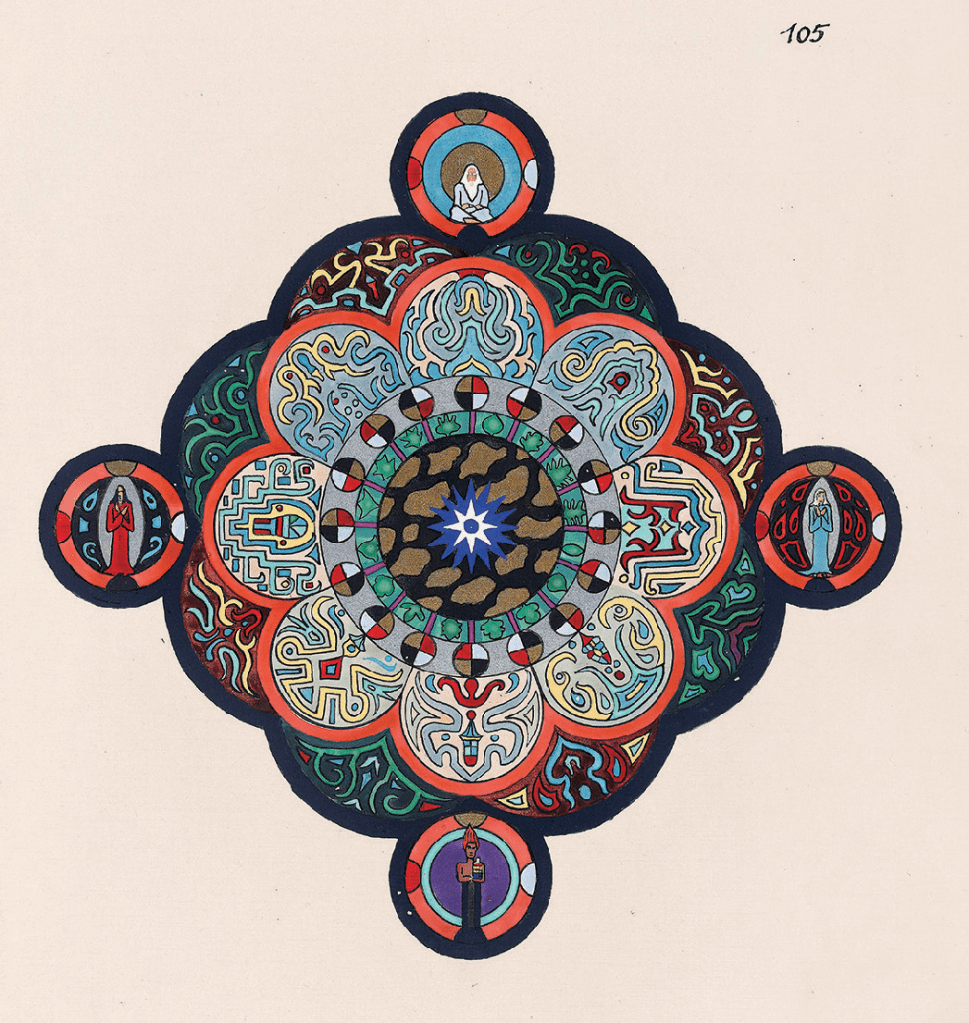
Reflections on Tolle, Jung, and Individuality

The Art of C.G. Jung

Over the past couple of years, I have been committed to learning about ideas which focus on cultivating and enriching spiritual enlightenment and liberation for a health focused and purpose-led life (perhaps this came to the forefront of my mind because of the pandemic causing existential considerations of what matters to people and systems).  For me, this exploration came in the serendipitous encounter of Eckhart Tolle’s book A New Earth in my neighborhood’s Little Free Library book stand.  I went on to read his first bestseller The Power of Now, which ultimately led me into reading and blogging about an entire spectrum of New Age writers including Louise Hay, Wayne Dyer, Masaru Emoto, and then Deepak Chopra and my journey into studying Ayurveda as in depth as possible as a novice to a complex topic that includes thousands of years of tradition from India. 

Overall, many of these New Age writers had me in an intellectual grip without a doubt…I felt a sort of spiritual transformation reading these books, which is not a small thing to say. I began meditating quite often and learned different ways of meditating. I think meditation is a tool to unlock subconscious thoughts and believe it’s a tool that should be taught earlier in our lives than later. It affected my approach to how I thought about what matters – how we approach each and every day and how our attitudes shape our micro and macro experience in the world is what defines our human experience.  However, this is not to say that it transformed my personality.  If anything, it affirmed what I already had set forth with creating: a world of rosiness and softness as a vehicle for navigating complex information.  My New Age studies became an opportunity to journey into understanding the “self” vs. the “Self.”  The work of egoic detachment never stops, and in my opinion, is a rather fruitless endeavor over time.  From the ideas Eckhart Tolle presents around “presence” and “nowness” as the only state of our lives to be concerned with, I have found there to be some essential faults with his teachings when put into practice.  Ultimately, those lived experiences led me to two truths that I can separate and examine: The first truth is that there is a universal oneness of source energy we are all a part of. This is technically separate from ideological concepts around God, but can be merged together with God dependent on your cultural ideological conception of God. I am a Roman Catholic and have found inner peace through my Christocentric journey. I also support the peaceful existence of alternative religious doctrine which adheres to a peaceful reciprocity of this goodwill. In my opinion, we are all part of a “source energy” that we all collectively belong to and theology complements that journey to optimal health and spiritual wellbeing. The source energy that brings us to this life also takes us from this life (it is up to you how you comprehend the idea of God as an entity separate or part of oneself, we are bonded through a source energy in any event).

    The second truth we can explore is that our experiences shape us as individuals: culture, ideology, social norms and we should do our best to develop our individuality. These things do shape us into who we are – it’s too much to ask of ourselves to abandon all of what comprises us as individuals to focus on awakening as a collective as Eckhart Tolle asserts through his teachings.  The real importance of individuation necessitates physical survival – the ego survives for a reason.  We are composed of all those “things” (gender, culture, religion) which Tolle tells us to negate ourselves from to have spiritual enlightenment as a collective.  This is truly nonsense in practice. His discussion points around disconnection from the “thinking mind” and ego become too abstract to truly find purposeful action within.  We all live and navigate within highly complex systems. Tolle’s ideas around liberation from the ego are too disconnected from real life and how societies operate. As a result of this deep reflection for myself, I have begun to embrace and study Carl Jung’s interpretations around the “shadow self” and how doing “shadow work” is how one can truly find their life’s purpose.  His connection to mandalas and Eastern Thought are especially important tools for these reflections.  

    Jung connected to ideas from Buddhism and believed in respecting and including the whole of an individual’s experience, including their “shadow” aspects.  In my opinion, the Jungian shadow is what will unlock liberation and maintain individuality for each of us.  In Eckhart Tolle’s view, the meaning of life is through a negation of the ego (individualism) and attaching oneself to a universal collective source energy as being a form of endless joy… his ideas around separation from the ego brings the nirvana of universal source energy as our entrance into conceiving infinity (given the science of black holes in the universe – infinity definitely exists). However, just because infinity exists does not mean humanity survives through a furthered attachment to universal source energy, nor do cultures survive this way.  Humanity survives through connection between individuals who create life and further generate individuality this way.  Individuation is our liberation. The ego is too hard to detach from as human beings and there are biological reasons for this.  The ego will not be the demise of humanity – the ego will enable our survival.  Tolle states how collective consciousness is part of the next phase of human evolution.  I highly doubt we will have the ability to culturally dissociate that much, especially during a time in the world where cultural separations became glaringly apparent.  I do connect to the ideas Tolle presents related to the importance of our present moment and do think he presents tools which empower people to overcome challenges and hardships through a focus on what you can do to take positive action in the moment. Beyond that, I see individuality and connections to other individuals as the answer to our liberation and not collective consciousness as liberation.

    I believe that the real inner truth we can find within ourselves is that humanity will survive longer when we focus on ourselves as individuals. We find peace in the boundary separations of our individuation by respecting individuality as our core truth.

      Rosy Conversation with Jeremy Burrows

      Jeremy Burrows is a longtime executive assistant, international speaker, author of the #1 bestselling book, The Leader Assistant: Four Pillars of a Confident, Game-Changing Assistant, founder of The Leader Assistant Community, and host of the #1 podcast for assistants – The Leader Assistant Podcast. Jeremy has worked with CEOs, professional athletes, Fortune 100 board members, and billionaires across the nonprofit and for-profit sectors. Jeremy has had the opportunity to speak to assistants all over the world at multiple conferences of various sizes in Hong Kong, Thailand, Germany, and the United States.  He’s currently Senior EA to the Founder and CEO of Capacity – a fast-growing, artificial intelligence software company. Jeremy’s passion is to help you lead well, resist burnout, and automate before you’re automated. Jeremy lives in Kansas City, MO with his wife and 2 boys. To connect with Jeremy or learn more about his training resources for executives and assistants, visit LeaderAssistant.com

      It is with great pleasure that I share my interview with Jeremy on Rosy BVM.  For my professional background, I have served as an Executive Assistant for one of the world’s leading management consulting firms for over seven years.  I have experience understanding the unique challenges that assistants can face and what it means to bring consistency and high quality executive support in rigorous client-facing environments.  Jeremy and his book, The Leader Assistant, is a breath of fresh air in an industry that sometimes can be marred with so many differentiated ideas of the successful EA role.  

      Assistants across industries have more cross-cutting capabilities and commonalities than they initially might think. As an Executive Assistant, you can sometimes feel at odds with the positionality of the role you play within your firm. For example, Executive Assistants can be referred to as “gatekeepers” for discretionary information purposes and are not meant to hold the most approachable role in a firm as they are uniquely positioned to perform by ensuring the most effective use of their executive’s time, thus making their executive less available might be one aspect of the success in their role (this is often supporting executives at a C-Suite level).  However, the other side of the work as an Executive Assistant can also be true, where Executive Assistants are seen as the culture carriers of an office and are regarded as extremely collaborative, approachable individuals who work cross-functionally and adapt to the needs of their executives with flexibility and precision. Both scenarios are true and more often than not, EAs are known to be the “go-to” people in a company. 

      Both scenarios of EA styles can be true, and as an Executive Assistant there is room for professional style shifts depending on a certain role and there is always learning to be done in between (sometimes throughout the duration of a career) and finding a sense of community as an assistant in the field becomes highly valuable.  Enter Jeremy Burrows, the leading voice for Executive Assistants and the communities which underpin the fascinating executive support industry. The vast and extensive style of executive support that exists displays how remarkably valuable executive support truly is when there is alignment between the firm’s purpose and goals and the ability for assistants to lead and thrive.

      Bianca: What inspired you to pursue a career as an administrative professional / Executive Assistant?

      Jeremy: Honestly, I never thought I’d be an assistant, but at some point, I fell into an assistant role and quickly realized I was good at organization, details, and project management. From there, it kind of progressed slowly over time until I ended up in the C-Suite as an EA.

      Bianca: You have created a noteworthy online community, The Leader Assistant, which connects and supports administrative professionals in online forums such as LinkedIn.  What are the amazing benefits of joining such a community and how did you start this? 

      Jeremy: The first nine years of my career, I did not network with anyone, let alone assistants. But when my prior executive was fired unexpectedly, I decided it was time for a career change, and suddenly needed that network that I didn’t have. I started reaching out to assistants on LinkedIn almost every day. I started becoming active in other assistant communities, and to put it simply, put myself out there. 8 years later, I’m humbled to have gathered a global community of Leader Assistants.

      Bianca: You have written a bestselling book about Executive Assistants called The Leader Assistant: Four Pillars of a Confident, Game-Changing Assistant, a bestseller on Amazon that was released in 2020.  What gave you the idea to put these ideas to paper and share with others? 

      Jeremy: After 3+ years of blogging, networking, and training assistants, I started seeing what content was helpful to career administrative professionals. I wanted to replicate the coaching and training sessions I’d had in a format that was accessible to assistants all over the world. So I wrote the book. 🙂

      Bianca: What makes you proud of your work as an assistant? 

      Jeremy: Nothing makes me prouder than helping other people and teams reach their goals. 

      Bianca: You work as an EA in the Artificial Intelligence sector right now, correct?  This has become a fascinating yet fraught topic in mainstream discourse regarding the potential misconception of how AI could “replace” assistants in a broader context.  What are your thoughts around the human experience as a critical part of guiding the executives and leaders as administrative professionals? 

      Jeremy: Yes, I have worked in the AI industry since 2017. In short, executives and assistants need to embrace automation and AI before they are automated. But, the best way to embrace AI and automation is to start with a problem to solve, then explore an AI solution to solve it. 

      Bianca: What motivates you to strive for excellence?  Do you tap into your community as a source of motivation as well? 

      Jeremy: I’m motivated by helping others, so anytime I can play a small part in someone’s success, I’m grateful. And yes, I definitely tap into my community to motivate me. They are so supportive and encouraging.

      Bianca: Thank you for your time, Jeremy, I certainly plan to stay a part of this assistant community!