
About Jayne Mansfield

Jayne Mansfield lived an enormous life in just 34 years. Today, she is most well known by people for the infamous photo of Sophia Loren glaring at Jayne’s robust cleavage while Jayne is smiling joyously. She is perhaps best known for these types of “stunts,” she was well known for publicity stunts in the 1950s that elevated her status, and she became extremely well known during the time. Sadly, Jayne also had to live in the shadow of Marilyn Monroe, which did affect her, ultimately driving her towards alcoholism and drug abuse. Jayne was never given “big roles” to act in, because large studios viewed Jayne as a type of “insurance” to back up Marilyn, though Jayne did win a Golden Globe.

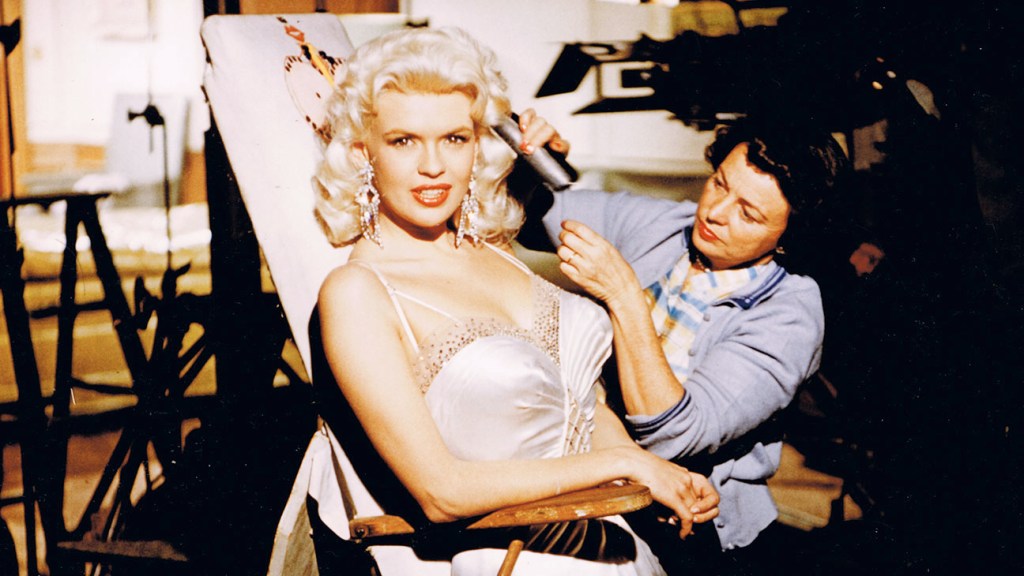
Jayne was incredibly talented and also incredibly underrated. Both Marilyn and Jayne were originally brunettes who were dyed platinum blonde and turned into film studio bombshells and fulfilled the “dumb blonde” archetype, which they were anything but. They also shared in the history of being two of the first Playboy Playmates alongside Bettie Page, which was revolutionary for the sexually oppressed 1950s. These were clever women, and in Jayne’s case, she orchestrated reality TV style publicity stunts before reality TV existed, as written about in The Hollywood Reporter by Erik Liberman in 2017. He writes how Jayne was the first version of a reality persona. She also carried around a chihuahua, as Paris Hilton is known for doing.

The infamous photo of Sophia Loren and Jayne Mansfield
Jayne was naturally a brunette

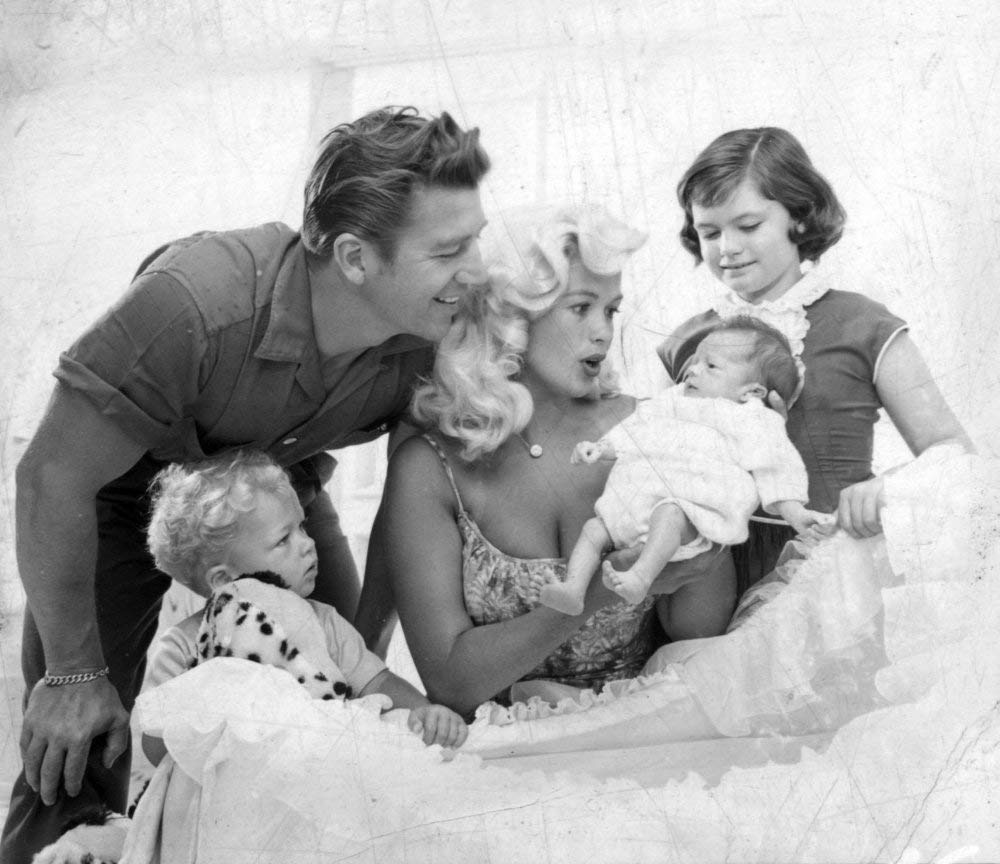
Jayne Mansfield was born Vera Jayne Palmer in Pennsylvania on April 19, 1933. Jayne was married and divorced three times and had five children. Her great love was likely with her second husband, Mickey Hargitay. She had her daughter, Mariska Hargitay, the well known actress, with Mickey. Mariska followed in her mother’s footsteps. Mickey clearly loved Jayne endlessly and put up with a lot of stunts that she pulled, which were not always family oriented; he stayed with her even when she was taking risks with sharing her sexuality.

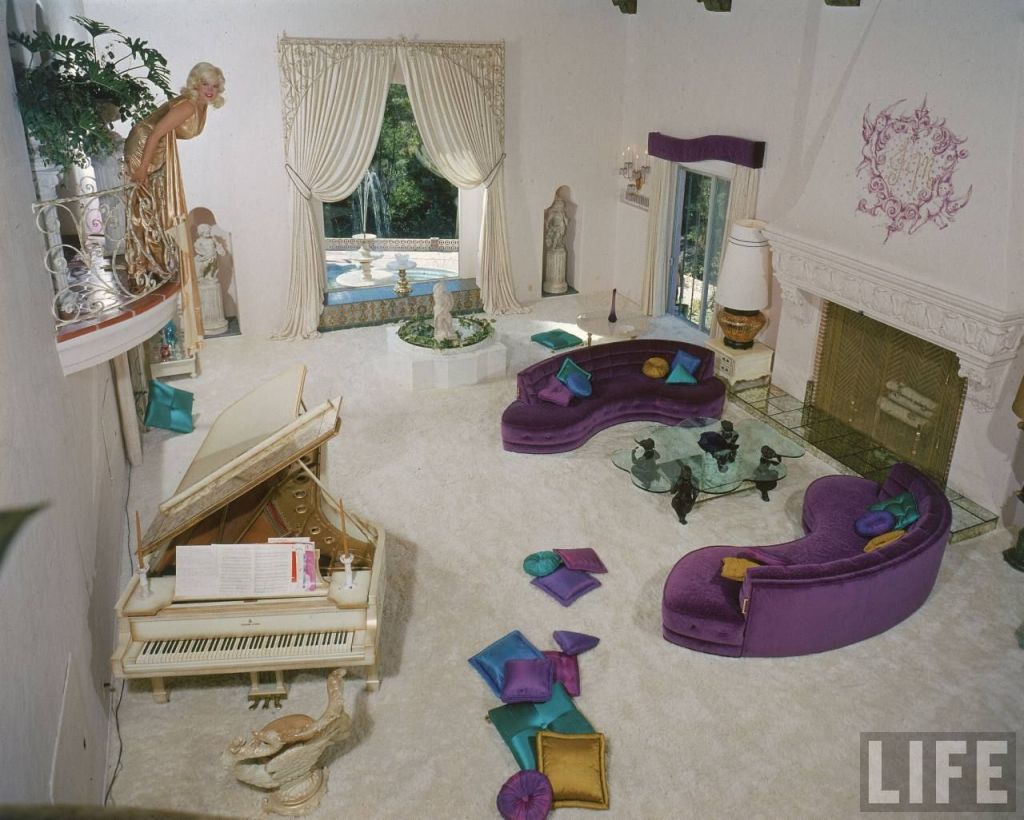
Jayne led a complex life: she pursued fame despite knowing that she was in the shadows of Marilyn. Jayne was also known for relationships with both JFK and RFK. She was certainly a woman who was ahead of her time in how she managed her life. Jayne had an ambitious vision for the star that she wanted to be and she made strategic decisions that impacted this vision. Jayne’s home in Los Angeles was even infamously dubbed the “Pink Palace” for having a pink theme and being painted pink. The grandeur that she lived in reflected the glamorous vision that she had for her life. Jayne’s life would end too early in tragedy.

Jayne performed in Mississippi during her last days in 1967, where she passed tragically in a car accident late in the night with her companion at the time, her lawyer, Sam Brody as they were going to New Orleans for another show. The vehicle Jayne was in crashed into the rear end of a tractor trailer that was behind a truck that had suddenly slowed down because it was spraying mosquito spray. Jayne’s children survived with minor injuries in the back seat.

After Jayne’s tragic passing, policy was passed to recommend that tractor trailers use an underride guard, though the trucking industry was slow to adopt the change. It’s sometimes referred to as the Mansfield Bar due to Jayne’s passing. Mickey, in despair, ended up marrying the flight attendant who accompanied him when he flew from Los Angeles to New Orleans after Jayne’s tragic passing in 1967. Mickey’s love for Jayne was so evident in how he allowed her to pursue her dreams. Jayne’s legacy is her ambition and her love.
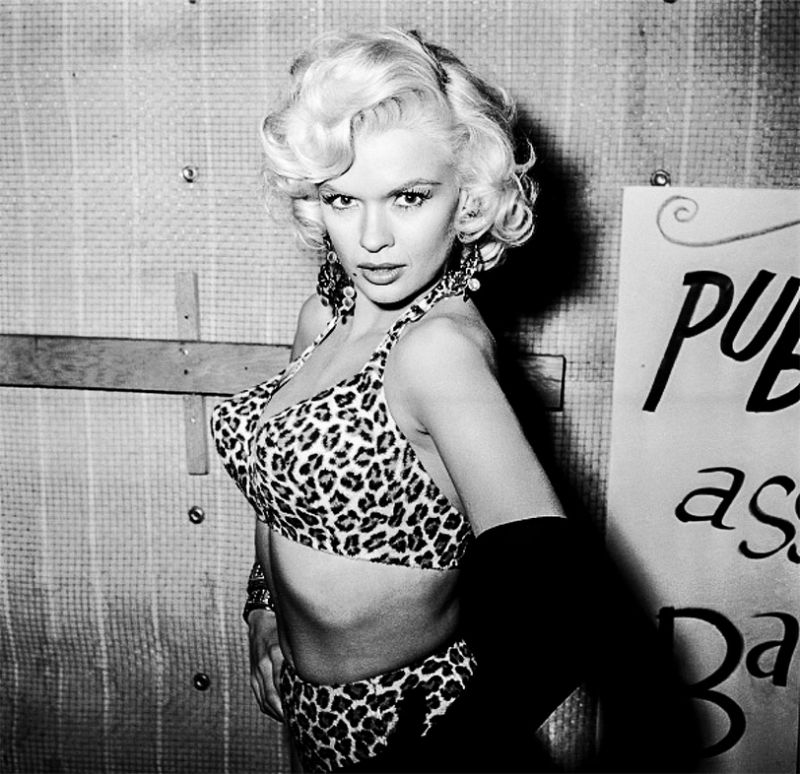
Jayne and Mickey were married in a ceremony in 1958 that was open to the press: an early version of a reality show.
Jayne with her husband Mickey and her three children with him.

Middle of Nowhere: The Forgotten Heartland and Mythology of Kansas

Kansas is in a compromised state: there is a deeply concerning economic stagnation happening in America’s heartland. Part of it has to do with an aggressive type of neoliberal realpolitik that has shredded the governance structures from having the programs needed to help bolster the state’s vibrance. The lack of taxes being paid by its population and the shredding of government agencies has had an opposite effect than intended initially to spur growth for the state through an experimental budget for the state which wreaked financial havoc (ideologically, the idea is that less taxes would spur growth). In the case for Kansas, the tax cuts were an extreme kind of neoliberalism that has caused the state real harm. The state is currently trying to manage this disrepair.

This is not just a red and blue issue, the heartland is in dire straights and there is no clear path to spur growth, but shredding taxes and government agencies is also not the answer. At this point, the state of Kansas needs a large philanthropic donation to help subsidize lack of government programs, spur economic development, and bring more vibrance back to this state.

The state of the nation depends on the vibrance of all states.

For the first time in years, Kansas has a Democratic Governor. Why is that? The realization that the course that this state is on as it previously had been as a staunchly “red state” is no longer working out. That’s a fact. Join me as I explore how Kansas is an economic thermometer for America. Furthermore, this state has its own mythology as part of American culture:

  • Dorothy from The Wizard of Oz is from Kansas
  • Superman is from “Smallville,” Kansas
  • Little House on the Prairie is in Kansas

How many people can say that they appreciate Kansas? Likely a huge number of Americans can tell you that’s what they know about Kansas from popular culture which includes the above films and books, which is great, but do they know what’s really been happening there in current times? It’s not been doing well.

The reality is, the state has had a decline in population size for the last 80 years. As a result, the state has taken drastic measures to improve population growth which is not limited to aggressively cutting government agencies in order to offer up to $15,000 for people to help pay their student loans in exchange to move to certain counties that need larger population sizes. This is a program that was created in clear desperation because people have been fleeing Kansas, mostly because there is a lack of opportunity. There is hope though.

The current Democratic Governor of Kansas, Laura Kelly, has taken steps to ensure that there are policy changes. For example, the experimental Kansas budget led by former Governor Sam Brownback led to cuts in schools, roads, and public safety. Governor Kelly is working to reverse those changes currently. They should be reversed with swift action.

A few other actions that Governor Kelly has worked toward is improving the pay for educators, thus improving the education system by attracting talented educators to the heartland.

She is also currently working to expand Medicaid to ensure that more people have access to healthcare. She also worked to reinstate LGBTQ equal workers rights. The policies being presented by Governor Kelly are sensible and in the interest for the economic wellbeing of the state. Clearly, states need some basic infrastructure to help spur economic growth, not aggressively cutting government services.

Marketing for the heartland of this nation has always been a challenge. Early into its history, the marketing message made to be appealing was FREE LAND. This was initially to draw in farmers. Now, one of the pulls was the following: “We will pay for some of your student loans if you come live in one of our counties.” Is that a sustainable offer? Likely not, as the program needed to be subsidized and there is no guarantee or expectation that people will stay for the long haul: this experimental budget led to serious infrastructure cuts which caused damage to the state.

Kansas may not be getting the structural attention that it deserves, but my eye is on Kansas as the pulse of economics in America, as it can be on the upswing when sensible policies and fiscal priorities are in place.

Tom Welling portraying Clark Kent (Superman).
In the long run, the yellow brick road is sensible fiscal policies which sustain government programs. Ideally, philanthropy can also help bolster the state’s economic wellbeing. Furthermore, all states should have a similar outlook in its policy management.

Aphrodite, Gilda, and the Violets

Rita Hayworth as Gilda

Love is the purest form of a soul at peace. 🕊

The birth flower for February is the violet. The month of February is also characterized by love as Valentine’s Day is also in February. The Greek Goddess Aphrodite is connected to such symbols as the rose, the violet, the dove, the swan, and the scallop shell to name a few.

There is an interesting intersection of meaning for the violet though. The meaning behind violets is the following: Violets symbolize modesty. According to Greek mythology, violets were created when one of Artemis’ nymphs, who had all sworn to stay maidens, was being pursued by her twin brother, Apollo. To protect her nymph, Artemis transformed her into a violet, which in turn led the violet to become a symbol of modesty. The violet also has roots in Christianity and represents the modesty of the Virgin Mary. The violet also represents spiritual wisdom, faithfulness and humility which are meanings that can be seen depicted in religious works of art.

Because the violet has an intersecting identity of modesty and has a connection to the spirit of love represented by Aphrodite, there is significant overlap between the qualities of purity by the Blessed Virgin Mary (BVM) and the more hedonistic identity of Aphrodite. The establishment of the violet in February allows us to consider how these intersecting meanings all lead into one concept: the power of love.

There are continued images of Aphrodite and violets in popular culture as well. For example, the actress Rita Hayworth was nicknamed “The Love Goddess,” at the peak of her career; her pinup image was also the most widely seen of WWII. As a mythological figure, Rita Hayworth certainly represents a more modern day image of Aphrodite. Directors like Martin Scorsese have also provided extensive input on how her acting set a bar that had not yet been achieved especially in her iconic role as Gilda.

Furthermore, it’s widely known that Rita unfortunately suffered from Alzheimer’s Disease for more than 20 years which may have been brought out earlier in her life due to some of the traumatic experiences she endured. Rita became the first public face of Alzheimer’s. Due to her high profile, there has been a dramatic increase in Alzheimer’s research funding and every year in her honor, the Alzheimer’s Association holds a gala in her honor. In 2019, the gala raised $1 million for Alzheimer’s research.

The gala continues to raise awareness and honors the life of Rita Hayworth in tandem. The official designated color for Alzheimer’s awareness is purple (violet), which is no surprise to me because of how violets are connected to meaning of love. However, this color was designated for political reasons: red + blue = purple, because this disease should never be politicized as it affects anyone regardless of their political affiliation.

In so many ways, the connections between Rita’s pinup role as America’s “Love Goddess” in WWII and her experience suffering from Alzheimer’s, Rita was a great unifier. Lack of unity and agreement… isn’t this all part of the great paradox of the political issues that we all face and let ego disavow us from shared agreement? The real answer is peace and love, regardless of which side you think you are on.

“She had an unusual combination of an innocence and an experience… a power and a vulnerability.” – Martin Scorsese